Support Built Into the Tree Itself
Tree Cabling in Lubbock for weak unions, split limbs, and mature trees at risk of failure
TX & NM Tree Service installs tree cabling on mature trees in Lubbock where a weak union or splitting limb threatens the tree's structure or the property below it. The owner diagnoses each tree first and explains directly what cabling can and cannot accomplish, so the decision to cable is made for the right reasons rather than as a default response to any visible crack or lean. Older oak and elm trees on established Lubbock properties are among the most common candidates, as their scaffold limbs can develop included bark at the union over decades, a condition that looks stable until it isn't.
The work begins with an assessment of which limbs or unions actually need support and whether cabling is the correct intervention for that tree's species, size, and structure. Not every split limb is a cabling candidate—some need removal, and some are stable without intervention. When cabling is the right answer, TX & NM Tree Service installs the system to accepted practice for the species and limb diameter involved, with a certified two-person crew handling the installation. Toby, a tree cutter with seventeen years of field experience, is part of that crew.
Schedule an on-site assessment to determine whether the tree on your property is a strong candidate for cabling or whether a different approach would serve it better.
How Tree Cabling Addresses Structural Failure Risk
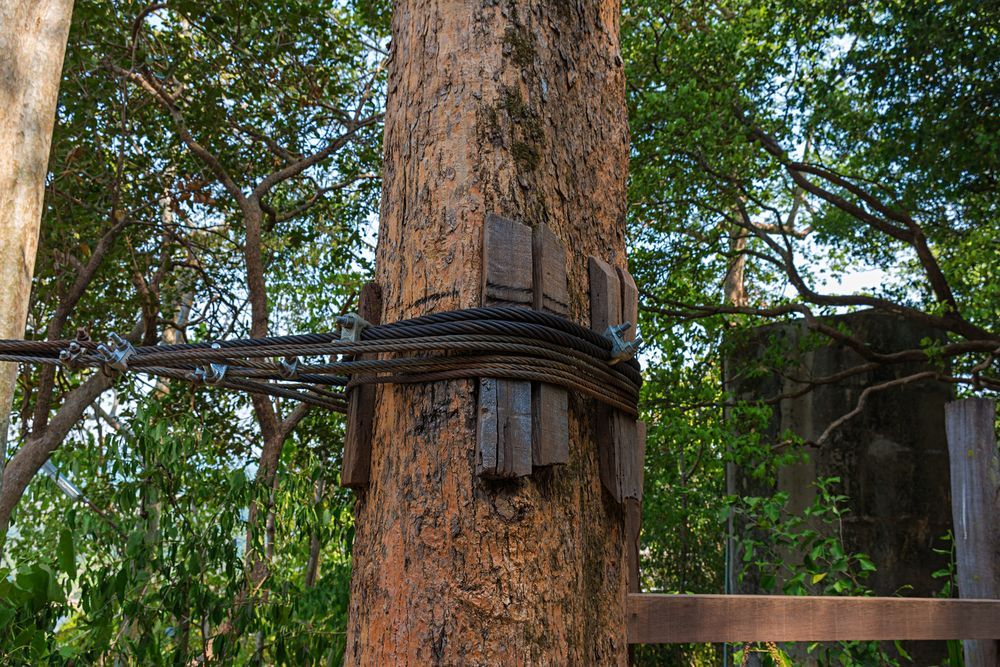
Tree cabling works by installing a high-strength cable between two anchored points in the canopy, typically between the codominant stems or between a weak limb and a structurally sound one, to limit how far those limbs can move independently during load. The anchor points are positioned above the union being supported so the cable carries tension before the limb reaches the angle at which the wood would fail. The height of the anchor points, the cable tension, and the hardware used all vary based on limb diameter and the species being worked on, because different trees have different wood density and growth habits that affect how the system performs.
Once installed, the limb or union is no longer bearing its full dynamic load alone during high-wind events. You will not see the cabling change the tree's appearance significantly from ground level, but what you will notice is that the limb is no longer moving independently of the canopy—the cable keeps the structure acting as one unit rather than two pieces pulling apart. For a mature oak or elm positioned near a house or fence line, that difference is observable and meaningful.
Cabling is not a permanent fix that eliminates all future monitoring. The cable system should be inspected periodically as the tree grows, since limb diameter changes can affect how the hardware fits and what load the cable is managing. Confirm with TX & NM Tree Service at the time of installation what follow-up inspection looks like for your specific tree.
Common Questions About Tree Cabling Work
The questions below address what happens during cabling installation and what property owners should understand before the crew arrives.
What does the assessment before cabling actually involve?
The arborist examines the union or limb in question, evaluates the wood condition at the attachment point, and determines whether the failure risk is structural or cosmetic—because that distinction changes whether cabling is the right response or whether pruning or removal would address the problem more directly.
How is the cable anchor point positioned in the tree?
Anchors are typically placed at two-thirds of the distance between the weak union and the tips of the limbs involved, so the cable intercepts movement before the union reaches its failure angle rather than after.
Why does species matter when choosing a cabling approach?
Wood density and growth rate affect how hardware is set into the tree and how quickly the limb diameter will change around the anchor, so the hardware selection and installation method are adjusted for oak versus elm versus other species common on Lubbock properties.
What should you look for in the tree after cabling is complete?
The limb should track with the canopy as a unit during wind rather than separating at the union, and the hardware at the anchor points should sit flush without bark swelling around it in the first growing season.
When does a split limb need removal instead of cabling?
If the wood at the union has already separated far enough that the cambium connection is lost on one side, cabling holds the limb mechanically but does not restore the vascular connection, and removal becomes the safer long-term option.
TX & NM Tree Service can review photos of the tree before scheduling, which helps narrow down whether an on-site assessment is the right first step or whether the situation calls for something different. TX & NM Tree Service also performs tree cabling in Slaton, Wolfforth, Levelland, Idalou, and Clovis. Call (806) 789-4297 to start the conversation.